China in violent revolts, Mussolini poking for trouble in opium-exporting Balkans in 1927... (link) What could possibly go wrong?
21JAN1929: At the 7th meeting of the League of Nations Opium Advisory Committee in Geneva, the most relevant information came from Serbia. The country had been renamed the Kingdom of the Serbs, Croats and Slovenes after the 1914 assassination of Archduke Franz Ferdinand. That event escalated the ongoing Balkan opium Wars into a full-fledged World War 1 in one of the most lied-about causal sequences in history; lots of countries changed names.
Speaking for the Kingdom, Mr Militchevitch apologized for the 1927 drug statistics report having missed the deadline and--wryly quoting Danton--observed that his Economic Review article on how League suppression had increased the profits of Balkan opium farmers had cost the Kingdom its place on the USA-dominated Permanent Central Opium Board. League activities and reduction of tobacco plantations had greatly improved regional opium sales, Serbia's 1928 poppy harvest having been exceptionally large--something like 200 metric tonnes of opium. Low tobacco prices eliminated that plant as a substitute crop. Eighty tonnes of opium still remained as unsold surplus in Serbia. But League publicity had advantageously put local producers in touch with foreign importers, and most of the dope exported in 1928 had gone to Germany, Switzerland, England and the USA--a new customer! Still, Militchevitch bragged, opium production in Southern Serbia was half what it had been before The War.
No surprise there either. Post-Boycott China had in 1906 reversed its policy of cultivating poppies everywhere so as to avoid a repetition of currency-weakening imports under absolutist prohibition. The move also reassured American politicians they weren't being used merely to enrich China's domestic dope monopoly. One predictable result was the 1911 Revolution unseating the Qing. That revolt replaced the Empire with warring nationalist and communist warlord factions. Peking Daily News reporting described how all Chinese ports were suddenly sealed against foreign opium cargoes as of 1912--effectively cutting off the income of Balkan poppy cultivators. Resulting economic panic worsened tribal friction among Christians and Moslems, and Carnegie-funded historians hastened to label the resulting unrest as Balkan Wars--rather than the early stirrings of Opium War Three. Why should America's Republican politicians admit any responsibility for pushing the world into another opium war? While caving to China's 1905 boycott demands, Republicans wanted to restore exports to China so as to not lose the farm vote. Grain and cotton exports would hopefully keep grain prices high enough to placate farmers, thereby avoiding another anti-sumptuary Democratic presidential victory like that of 1892. How were Republican Prohibitionists supposed to know that outlawing production and trade leads to panics, recessions, unemployment, market crashes and war?
So fourteen years later, in postwar Geneva, it turns out that Serbia, exporter of the world's strongest opium, made a killing thanks to League publicity. The lengthily-renamed kingdom, freed of Austrian and Ottoman domination, was now sitting on 80 thousand kilos of the world's most expensive opium containing 14% morphine. Nice work, if you can get it. Serbian negotiators got one of their own on the Central Board as recorded at the 18FEB1925 Opium Advisory meeting. American cigarette manufacturers would have to look elsewhere for cheap, subsidized tobacco.
Good reading: POLOSTAN, by Neil Stephenson (link). After thousands of pages of League wrangling and pitiful financial flops, this retro-sci-fi atom spy novel hit the spot. First in a series of Bomb Light novels it features a Heinleinesque female heroine protagonist alternating between 1930s USA and the fledgling Soviet Union. The background is as vivid as a movie, and struck me as historically and technologically accurate. I can hardly wait for the next in the series. I have nothing positive to say about Ahamed's Lords of Finance, but it is popular with economists unfamiliar with Prohibition, The Hague, WW1, The Great Depression and causation. Nor dare I comment on The Panic of 1792 written by someone evidently unaware of the Whiskey Rebellion. I recently bought it but Kindle says it's already out-of-date and I have to install a new operating system to read it again. No thanks.
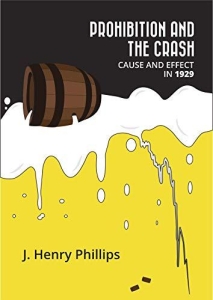
Get the big picture inProhibition and The CrashonAmazonKindlein two languages. After this you’ll be able to explain to economists exactly how fanaticism and loss of freedom wrecked the U.S. economy.
Prohibition and The Crash, on Amazon Kindle (link)
ASYLUM APPLICATION FORM i589 INSTRUCTIONS IN PORTUGUESE: INSTRUÇÕES PARA O FORMULÁRIO DE ASILO i589. What we did was make the Political Asylum instructions accessible to and understandable by people accustomed to thinking in Portuguese. This costs one dollar ($1) and you can read it on a cellphone with the Kindle app.(link)
Brazilian Sci-fi from 1926 featuring the adventures of a Rio de Janeiro man-about-town and the beautiful daughter of an elderly scientist–touting alcohol prohibition, eugenics and racial collectivism. Go to Amazon.com and look inside America’s Black President 2228 by Monteiro Lobato, cover art by Rene Bueno, translated by J Henry Phillips (link)
I also produce books and articles in Portuguese, plus my own blogs using U.S., Australian, Canadian, Chinese, English, European and South American historical sources at http://www.expatriotas.blogspot.com or www.amigra.us and in English at http://Libertariantranslator.wordpress.com (link)
This financial history blog, http://www.Libertrans.us, in Portuguese is Expatriotas for Brazilians, readable at www.criseeconomica.com (link)
Do you need to contact a certified Translator or Interpreter?
Está procurando tradutor ou intérprete credenciado?






No comments:
Post a Comment