 |
| Economic collapse & communism everywhere |
April Fools' Day, 1932
SEC. 33. After February 1, 1920, the possession of liquors by any person not legally permitted under this title to possess liquor shall be prima facie evidence that such liquor is kept for the purpose of being sold, bartered, exchanged, given away, furnished, or otherwise disposed of in violation of the provisions of this title. Every person legally permitted under this title to have liquor shall report to the commissioner within ten days after the date when the eighteenth amendment of the Constitution of the United States goes into effect, the kind and amount of intoxicating liquors in his possession. But it shall not be unlawful to possess liquors in one’s private dwelling while the same is occupied and used by him as his dwelling only and such liquor need not be reported, provided such liquors are for use only for the personal consumption of the owner thereof and his family residing in such dwelling and of his bona fide guests when entertained by him therein; and the burden of proof shall be upon the possessor in any action concerning the same to prove that such liquor was lawfully acquired, possessed, and used.
***
The straw that broke the camel's back, consolidating the stock market Crash and launching the Great Depression was a ruling by Federal Judge Louis Fitzhenry that anyone who bought or possessed a bottle of beer could be sentenced to five years in prison. This interpretation of Volstead Sec. 33 was in light of the Jones Increased Penalties Act signed by Calvin Coolidge 2 days before Herbert Hoover's inauguration.The five in the Jones "Five & Ten" law made practically everything a felony, and by extension, failure to inform the police of a felony made practically all Americans into stool pigeons or felons.
Already in late August the New York Times and 20 other papers had begun publishing prosecutor Mabel Willebrandt's series on how deeply The Inside of Prohibition enforcement wove its tentacles into the penal, tax and banking system. Police, Customs and Prohibition agents turned out to be such superb organizers of profitable mischief that Willebrandt made sure they were required to inform on each other. The 1929 market downturn began as August ended.
Lysander Spooner had ironically observed of the dry laws in Boston 54 years earlier:
One answer is that if the fact that the use of liquors tends to poverty and pauperism be a sufficient reason for prohibiting the sale of them, it is equally a sufficient reason for prohibiting the use of them; for it is the use, and not the sale, that tends to poverty. The seller is, at most, merely an accomplice of the drinker. And it is a rule of law, as well as of reason, that if the principal in any act is not punishable, the accomplice cannot be. --Vices are Not Crimes, XXI
But superstitious hysteria cares little for the restraints of reason and causality. Reality made it explicit that laws making a crime of production and trade are what tend to poverty, with practically every country of Europe, Asia and South America confirming that truth. Neither the use nor sale of anything caused as much poverty as did tax-enforced Prohibition when it unleashed The Great Depression! Judge Fitzhenry blurted out his lamentable decision on 21NOV1929, after the Dow Jones averages had dropped by over a third and a New York banker, two Philadelphia brokers and a grain dealer committed suicide. Then, on 26NOV1929 Judge Fitzhenry was in the news again:
Federal Judge Louis Fitzhenry today issued a statement to correct an opinion handed down yesterday which, he said, either by inadvertent use of a word or by misquotation, conveyed the impression that he held any person knowing of another's possession of liquor to be a felon. (...) "I don't believe I said possession was a felony, but if I did it was incorrect," he said. "However any person witnessing a violation of the Jones Act without reporting it would be a felon."
Anyone can visit online newspaper archives and see that The Crash came as soon as word went out of a huge bank-subsidized liquor and drug smuggling syndicate suffered 35 simultaneous raids from Atlantic City across Long Beach to Montauk Point October 16, then worsened as police, Customs, NY banking department personnel, bankers and tycoons were dragged down by dope, bank fraud and murder cases from the US, to England and Germany as commerce was increasingly made a crime.
***

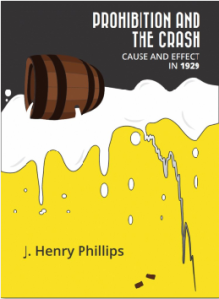
Find out the juicy details behind the mother of all economic collapses. Prohibition and The Crash–Cause and Effect in 1929 is available in two languages on Amazon Kindle, each at the cost of a pint of craft beer.
Brazilian Sci-fi from 1926 featuring the usual beautiful daughter of a scientist touting prohibition and racial collectivism in America’s Black President 2228 by Monteiro Lobato, translated by J Henry Phillips (link)

Brazilian blog…
American blog…
Tagged: prohibition, confiscation, asset forfeiture, initiation of force, blackouts, energy crisis, liquidation, liquidity, bankruptcy, Crash, Depression, communism, inviting attack, treason, economic collapse,


